
From a Simple Question to a Social-First Product
KOBA started with a question we all ask but rarely solve. How do you find people to play, move, and show up together? This is how we built a social-first product at Youth Hack 2025.

Before Youth Hack 2025 even began, we agreed on one thing: we wanted to work on a problem that actually mattered.
Not something abstract. Not something trendy.
Something real.
For us, that problem was finding people to do activities with. Sports, casual runs, badminton, futsal, fishing. The kind of things people enjoy, but quietly stop doing because they cannot find others or coordinate a plan. When that friction exists, staying home becomes the easier option.
That gap is where KOBA started.
Why We Called It KOBA
The name came naturally.
“Koba, neih futsal matcheh?”
It sounds like something you already say. No explanation needed. It feels local, casual, and human. That mattered to us, because the product itself is built around real conversations and real people, not abstract users.
Realizing We Had to Slow Down
Youth Hack 2025 was held at the Youth Hub in Malé. As we listened to the problem statements, something became clear very quickly.
Many teams would build some version of “find people to play sports.”
So we made a decision early. We would not rush. We would not start coding just to feel productive.
Instead, we spent time refining the product itself. What makes this different. Who it is really for. Why someone would come back after the first week.
That choice ended up defining everything.
What Most Fitness Apps Miss
Most fitness apps are built around the individual.
Track steps.
Track calories.
Track runs.
Maintain streaks.
All of that works, but it ignores something fundamental. Humans are social by default. Accountability works better when it comes from people, not numbers.
When activities are social, people show up more consistently. They stay longer. It feels less forced. And for many people, especially those who do not enjoy gym culture, sports and casual activities are simply more sustainable.
So we decided early that KOBA would be social-first, not fitness-first.
Designing for Everyone, Not a Niche
We did not want KOBA to target only athletes or gym regulars. We wanted it to work for beginners, casual players, and people who are just trying to move more.
That also meant taking safety seriously. Comfort matters. Inclusion matters. If people do not feel safe or welcome, they simply will not participate. A safe space is not optional if you want real adoption.
A Note on the Tech
We kept the stack simple but intentional.
The main app was built in Flutter, which let us move fast while keeping the UI consistent and clean. For the backend, we used Rust. Partly for performance, and partly because a hackathon felt like the right place to try something new and slightly uncomfortable.
For the landing page and pitch, we did something different. Instead of static screenshots, we used a 3D iPhone model rendered in Blender. The idea was to keep the focus on the product flow and make the presentation feel polished without overcomplicating things. We spent just enough time learning Blender to get it done, and moved on.
The Reality of 48 Hours
Hackathons look clean in photos. The reality is chaotic.
Over 48 hours, this is roughly how it went:
- 7 hours of sleep total
- 16 hours refining the idea and positioning
- 4 hours on UI and UX before writing code
- 20 hours of development
- 1 hour pulling the pitch together
At one point, Ali was sleeping on the floor using his MacBook as a pillow. We barely left the venue.
Our team setup helped a lot:
- 2 developers
- 1 designer
- 1 researcher
That balance let us move fast without building something shallow.
What KOBA Actually Does
KOBA helps people discover nearby activities, join lobbies that match their comfort level, and stay consistent through social accountability.
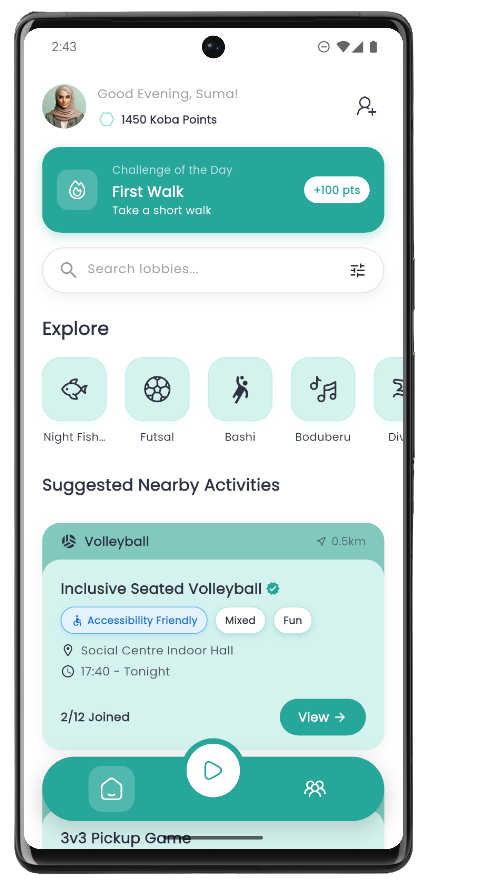
The flow we built was intentionally simple:
- A home screen with points and a daily challenge
- Activity categories
- Nearby activity cards showing distance, location, time, and tags like social, competitive, or training
- A clear join action
Attendance is verified by the host instead of relying purely on GPS. That small detail makes participation more reliable in real-world conditions.
On top of that, we added a light rewards layer:
- Weekly challenges
- Points
- Leaderboards
- Redeemable rewards
Not to gamify everything, but to encourage consistency.
Thinking Beyond the App
We kept coming back to the bigger picture.
KOBA can help people who are at risk of non-communicable diseases start moving in a way that feels social and enjoyable. But it can also become something more.
Over time, it can provide a high-level view of activity across the Maldives. Where people are active. Where participation is low. What activities people prefer. What times and locations actually work.
That kind of insight matters for public health, youth engagement, and community planning.
Why KOBA Won
We did not win because we wrote the most code.
We won because we were intentional.
We took time to differentiate. We built around social connection. We designed for safety and inclusion. And we made sure the idea could realistically work outside a hackathon.
KOBA started as a weekend project, but the problem it solves exists every day.
We are building it for real.